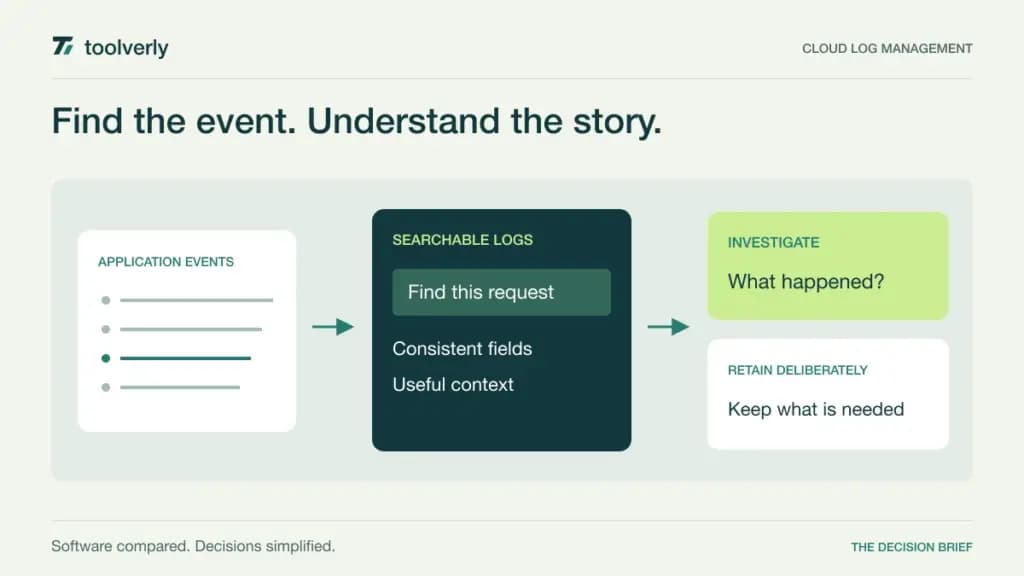
A useful log management platform lets an engineer answer a concrete question: what happened to this request, customer action, or background job? Collecting events is only the first step. The team must be able to find the relevant records, understand their fields, retain them for an appropriate period, and control the cost of doing so.
Datadog, New Relic, Better Stack, Axiom, and Logz.io offer different combinations of collection, search, retention, and observability. Their prices use different units, so headline numbers are particularly easy to miscompare. One service may charge for ingested bytes and indexed events; another separates storage and query compute.
Research checked October 1, 2026. This comparison uses official product and pricing documentation. We did not benchmark query speed, ingestion reliability, or incident outcomes. USD figures describe specific published components and billing terms, not a complete cost estimate for your workload.
Five cloud log platforms compared
| Product | Best fit | Main strength | Price reference | Meaningful tradeoff |
|---|---|---|---|---|
| Datadog | Teams considering logs within a wider observability setup | Separate ingestion and searchable-event controls | US$0.10/ingested GB; 15-day Standard indexing from US$1.70/million events on annual billing | Ingestion alone is not the full searchable-log price |
| New Relic | Teams evaluating a shared observability workspace | Data ingestion alongside platform access | 100 GB/month free; additional Original data at US$0.40/GB | User-based and compute-based purchase models differ |
| Better Stack | Teams wanting explicit ingestion and retention components | SQL-based investigation and configurable retention | US$0.10/ingested GB plus US$0.05/GB/month retained | Optional query acceleration and response tools have separate costs |
| Axiom | Engineering teams willing to budget compute and storage separately | Structured event analysis with configurable retention | Cloud: US$25/month platform fee plus usage | Query behavior, storage, and access-control add-ons affect the bill |
| Logz.io | Teams evaluating managed log investigation and data filtering | Search with ingestion optimization and storage tiers | US$0.92 per ingested GB per day, seven-day retention, annual terms | The daily-volume unit and retention terms need careful modeling |
Datadog
Datadog separates log ingestion from indexing. Its log-management pricing lists ingestion at US$0.10 per uncompressed GB. Standard indexing with 15-day retention starts at US$1.70 per million events per month on annual billing; the on-demand rate is higher. Parsing, tagging, live tail, archives, and log-derived metrics appear in the ingestion offering, while searchable indexing has its own pricing. Other observability products can add further charges.
Strength: separate controls encourage a team to decide which events need routine search and which need another treatment. During evaluation, classify a representative sample into operationally useful, diagnostic, and unnecessary records. Assign an owner to that decision so the configuration does not become an unexplained collection of filters.
Limitation: the ingestion rate cannot serve as an all-in search budget. Small events can produce a very different indexed-event count from large events with the same byte volume. Datadog fits teams prepared to model those dimensions and assess logs as part of their wider observability design.
New Relic
New Relic’s pricing page includes 100 GB of free data ingestion per month and lists additional Original data at US$0.40 per GB; Data Plus is US$0.60. Platform access is a separate consideration. The page describes user-based purchasing as well as a compute-based option for eligible plans. A free data allowance does not mean every employee receives every platform capability without additional charges.
Strength: New Relic is worth evaluating when logs are one part of a shared observability workspace. Ask an engineer to investigate a known application problem and document which data and access level they actually need. Repeat that exercise with a colleague who only occasionally participates in investigations; their requirements may differ.
Limitation: ingestion, user access, and alternative compute-based terms must be compared within the same commercial model. Avoid combining the cheapest element from incompatible offers into a fictional total. New Relic fits buyers who can define both their data volume and their investigating audience, then request a matching plan and retention configuration.
Better Stack
Better Stack’s logs and traces pricing lists ingestion at US$0.10 per GB and retention at US$0.05 per GB per month. A free allowance covers 3 GB monthly with three-day retention. The service supports SQL-based querying and transformations; standard queries are included, while Query Boost is listed separately at US$0.001 per GB scanned. Incident-response subscriptions and other products should be evaluated independently from these telemetry components.
Strength: explicit retention pricing makes it easier to discuss why a dataset needs to remain available. Ask each team to identify the investigations that require older records. A useful retention policy connects those needs to named datasets instead of keeping everything indefinitely because nobody wants to decide.
Limitation: ingestion is only one part of cost, and accelerated queries can introduce another usage dimension. Better Stack fits teams comfortable working with structured queries and managing data lifetime deliberately. During a trial, have an engineer unfamiliar with the original logging code find a failed operation using the fields your applications actually emit.
Axiom
Axiom’s current Cloud pricing starts with a US$25 monthly platform fee plus usage, without a minimum commitment. The listed included allowances cover 1 TB of monthly data-load compute, 100 GB-hours of query compute, and 100 GB of storage. Cloud supports configurable retention and Axiom Processing Language queries. Role-based access control and SSO are listed as separate paid add-ons, so identity requirements belong in the budget.
Strength: Axiom gives engineering teams a model that makes storage and query activity explicit. Trial a narrow operational search and a broad historical investigation, then inspect how each consumes resources. That exercise is more informative than estimating the bill from ingestion alone.
Limitation: buyers need to understand the vendor’s compute units and included allowances. A quiet dataset with long retention and an actively queried dataset can produce different cost patterns. Axiom fits teams willing to learn that model and put cost controls alongside their data design. Confirm the required permission structure before treating the base platform fee as the complete subscription.
Logz.io
Logz.io’s pricing page lists log management at US$0.92 per ingested GB per day with seven-day retention under annual billing terms; the page states a 1.2-times price for monthly billing. Preserve that daily-volume unit when requesting an estimate. Its log-management overview describes search filtering, a data optimization hub for inspecting and filtering incoming logs, and hot, warm, and cold storage options.
Strength: Logz.io is a useful candidate when the team wants to examine what it sends before expanding retention or capacity. Ask the evaluation team to identify a repetitive event stream, explain its diagnostic value, and show how the proposed filtering policy would affect a real investigation.
Limitation: a price expressed per daily ingestion capacity should not be compared directly with a simple monthly per-GB ingestion charge. Ask the vendor to price your observed daily profile, retention needs, and investigation access. Logz.io fits buyers prepared to evaluate data optimization and managed search together, with an explicit proposal for any additional retention or services.
Choose with a representative workload
Start with a modest sample containing successful requests, failed requests, background jobs, and one known exception. Record volume before and after any transformation. Check timestamps, service names, environment labels, and request identifiers. A platform cannot reliably connect events when the application emits inconsistent fields, and a faster query interface will not correct those records.
Separate event investigation from availability checks. Your uptime monitoring software may tell you that an endpoint is unavailable, while logs help investigate the path to that state. If releases use feature flags, decide whether relevant flag context should appear in application events so an engineer can compare affected and unaffected requests.
Run the same investigation with two people: the author of the service and someone covering for them. Measure whether both can find the relevant records and understand the answer. Treat that as a workflow evaluation, not a performance benchmark. Include a burst of repetitive errors in the cost scenario, since unusual operational periods are precisely when logs become most valuable.
- Estimate daily ingestion, event counts, retained data, and query activity.
- Confirm which data is searchable at each retention stage.
- Remove unnecessary sensitive fields before sending events.
- Check access controls and the cost of occasional investigators.
- Set ownership for filters, retention, and spending alerts.
- Price a normal month and a noisy incident scenario under one consistent plan.
Datadog and New Relic deserve attention within broader observability decisions. Better Stack makes ingestion and retention easy to separate, Axiom makes compute and storage central, and Logz.io invites a combined search and data-optimization evaluation. Choose the platform whose investigation workflow and complete billing model your team can explain.
Original illustration by Toolverly. Read about our publication or send a correction.