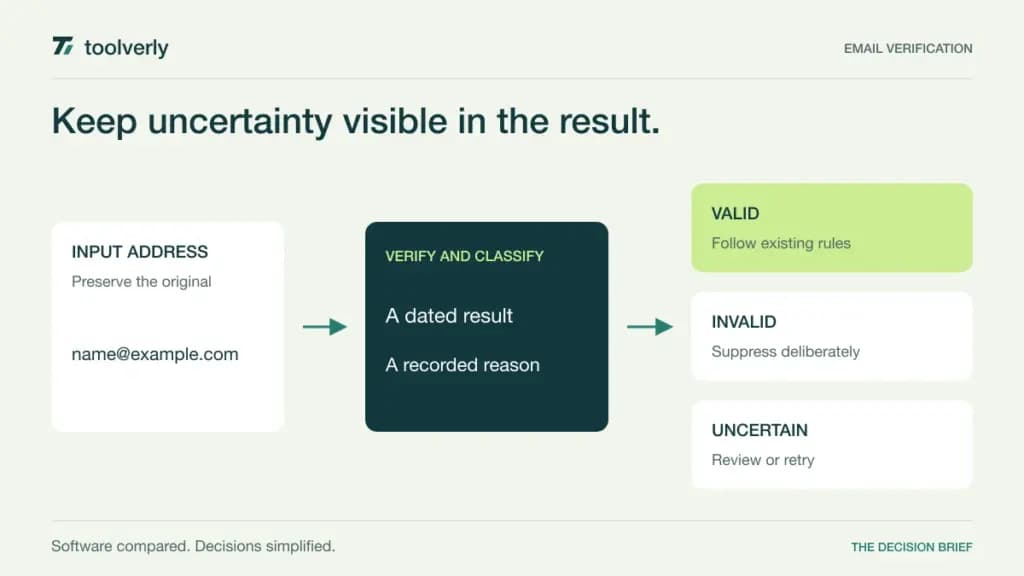
An old email list can contain typographical errors, abandoned mailboxes, duplicates, and addresses whose receiving servers do not reveal enough information for a confident verdict. Email verification software classifies those records before they enter a campaign or an application workflow. Its value depends on what your team does with the result, especially when an address is uncertain rather than plainly invalid.
We compare ZeroBounce, Emailable, Bouncer, DeBounce, and Validity Engage’s BriteVerify-powered contact quality capability. The decision is address validation and list hygiene. A sending service still owns message delivery, as discussed in our transactional email comparison, while campaigns and subscriber workflows belong to an email marketing platform.
Official sources were checked on October 6, 2026. We did not upload customer lists, send verification trials, or measure vendor accuracy. A verification result cannot establish a recipient’s permission, interest, or future inbox placement. Keep those records and decisions separate from technical address status.
Five email verification choices
| Product | Best fit | Main strength | Meaningful tradeoff | Pricing reference |
|---|---|---|---|---|
| ZeroBounce | Verification plus adjacent email diagnostics | Validation and separate scoring options | Credit rules and expiration require close reading | Pay-as-you-go and ONE subscription |
| Emailable | Flexible list cleaning and API usage | Shared verification credits and refund rules | Minimum credit purchase exceeds tiny list needs | 5,000-credit minimum; monthly option |
| Bouncer | Occasional cleaning and entry checks | Verification API and clearly separated add-ons | Shield and deliverability are distinct budgets | Volume-tiered credits |
| DeBounce | Bulk and real-time address classification | List cleaning with integration options | Result policy still needs human ownership | Prepaid verification credits |
| Validity Engage | Broader contact data quality operations | BriteVerify-powered email checks beside other contact checks | Current package and commercial scope need a quote | Request configured pricing |
ZeroBounce
ZeroBounce offers bulk and real-time email validation, with scoring and other email tools alongside it. Its pricing FAQ states that validation consumes one credit per address, while scoring the same address consumes an additional credit. This distinction matters when a team expects one upload to include every available diagnostic without affecting its balance.
The strength is a wider toolkit for teams that want to investigate address quality alongside their email operations. Detailed result codes can support a classification workflow, but the team should map those codes to its own actions. Choose it when someone owns uncertain results, separate scoring, and recurring cleaning rather than automatically treating every returned record as a sendable contact.
The official FAQ lists pay-as-you-go starting at $39 USD for 2,000 validations and ZeroBounce ONE from $99/month. Unknown results and duplicate removal do not consume credits. Credit expiration wording is mixed: a broad page label says credits never expire, while the detailed FAQ guarantees that during an active ONE subscription and says other expiration rules may apply. Obtain the applicable purchase terms instead of assuming all prepaid balances last indefinitely. Extra tools and scoring should be budgeted explicitly.
Emailable
Emailable uses one credit for a verification request across its bulk workflow, verifier, API, and widget. Its FAQ describes refunding duplicate and unknown results after a list completes. That structure fits a marketing operations team which cleans uploaded lists and also wants to validate addresses as new records enter a system.
Its advantage is a common credit model across several verification entry points. A team can define one result policy, then use it for a batch import or a live capture flow. Evaluate the exported columns and whether your existing integration can preserve a status and timestamp instead of replacing the original address without context.
The pricing page lists a 5,000-credit minimum purchase, non-expiring credits, and a monthly subscription discount of 15%. The displayed 5,000-credit figures are $38 pay-as-you-go and $32.30/month for the subscription. The subscription can be canceled and unused credits roll over. Inbox Reports use 100 credits per report and blacklist checks use five credits, so those activities have separate consumption. The main limitation for a small occasional list is buying a larger balance than today’s verification job requires.
Bouncer
Bouncer offers list verification and a verification API, while its public product navigation separates Shield, AutoClean, and the Deliverability Kit. This separation helps a buyer distinguish cleaning an existing list from screening an address at a form or running inbox-placement diagnostics. Those are related workflows with different owners and charging assumptions.
The strength is a relatively clear prepaid verification model. The current page lists a minimum purchase of 1,000 credits, with public examples of $8 for 1,000 and $60 for 10,000. It says on-demand verification credits do not expire and duplicated addresses and unknown results are not charged. These conditions make it worth evaluating for intermittent cleaning jobs where there is no reason to assume a monthly subscription is necessary.
The limitation is expecting a verification balance to cover every Bouncer product. Shield has its own monthly checks configuration, and the Deliverability Kit has separate subscription plans. Ask which integration preserves classification details and whether automatic cleaning changes your source records. Bouncer suits a team that wants to keep verification understandable while choosing capture protection or diagnostics only when there is a concrete need.
DeBounce
DeBounce combines bulk email validation with real-time verification and integration options. Its official site describes removing invalid addresses and identifying disposable, role-based, or uncertain records. These classifications are useful inputs for list operations, but they should be interpreted in context. A role address can be a legitimate business contact even when it is unsuitable for a particular automated campaign.
Its strength is a focused route from an imported list to categorized results, with an API for embedding checks elsewhere. It fits a team that wants to inspect a file, apply an explicit suppression policy, and preserve the decision back in its marketing system. Review whether integrations can update fields without erasing subscription status or independently maintained preferences.
The public pricing model uses prepaid verification credits with volume tiers; use the live calculator for the exact list size rather than extrapolating a small-volume unit price to a large purchase. The official page documents non-expiring balances and free deduplication. Standard validation consumes one credit, catch-all validation ten, and successful data enrichment twenty; list monitoring is listed at twice the list size per month. Price those activities separately rather than treating every check as one standard verification. The meaningful tradeoff is operational: even a straightforward cleaner cannot decide how your company should handle catch-all uncertainty or when an older valid result needs refreshing.
Validity Engage
The former BriteVerify domain now redirects to Validity Engage’s Contact Data Quality page. Its current email verification capability is explicitly powered by BriteVerify. The page describes syntax, domain, MX record, and mailbox checks returning valid, invalid, or risky outcomes. Phone and postal address validation appear alongside email as separate contact-quality capabilities.
This makes it relevant to teams managing contact data across more than a mailing list. The strength is assessing whether email verification belongs inside a broader quality workflow with a named CRM owner. Evaluate how the current Engage package connects classification to the fields and downstream systems your company maintains, rather than assuming a historical BriteVerify subscription describes the new offer.
The limitation is commercial clarity. The reviewed current capability page directs buyers to get started with Engage and does not establish a complete public per-verification rate. Treat pricing as a configured quote. Request the email volume allowance, bulk and API scope, uncertain-result treatment, retention terms, and any separately licensed phone or address services. Do not compare an old brand’s historical cents-per-email figure with another vendor’s current prepaid credits.
Build a result policy before buying credits
Create four actions: accept under your existing subscriber rules, suppress clearly invalid addresses, review uncertain records, and retry temporary failures. Preserve the vendor status, check date, and reason with each decision. This gives the next operator a way to explain why a record changed and prevents an unknown result from being mistaken for confirmed invalidity.
For a pilot, use an authorized sample that includes typographical errors, known working addresses, role addresses, and catch-all domains. Compare classifications and export quality without inventing an accuracy percentage from a tiny sample. Examine API timeouts and decide whether a temporary verifier outage blocks form submission or queues a later check. That is a product decision, not a default you should inherit accidentally.
ZeroBounce suits teams wanting adjacent diagnostics; Emailable a shared credit model across entry points; Bouncer a clearly bounded cleaning budget; DeBounce a focused classification workflow; and Validity Engage broader contact quality. Select on how reliably the status reaches its owner and how transparently uncertain outcomes are charged and handled.
Official sources
- ZeroBounce pricing and credit FAQ
- Emailable pricing and refund rules
- Bouncer pricing and verification overview
- DeBounce pricing and validation capabilities
- Validity Engage Contact Data Quality
Original illustration by Toolverly. Read about our publication or send a correction.